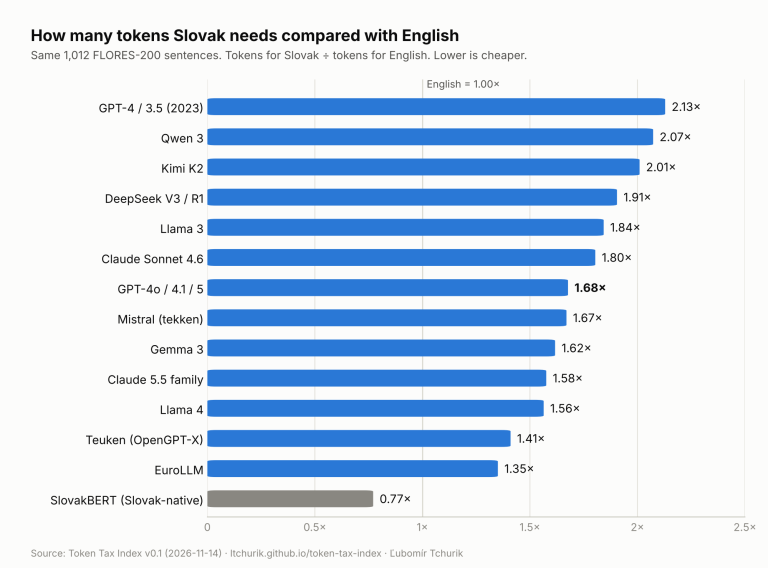

Every time a Slovak company sends a prompt to GPT-5, it pays about 68% more than a British company sending the same sentence. Not because of exchange rates. Because of how the model cuts text into pieces.
I run infrastructure for a handful of Slovak news sites, and when we started putting LLMs into the editorial pipeline the invoices didn’t match my napkin math. English benchmarks said one thing; our bill said another. So I did what you do when you don’t trust a number: I measured it myself. The same 1,012 sentences, 204 languages, 35 tokenizers. The result is the Token Tax Index, and this is what it says about Slovak.
The short version
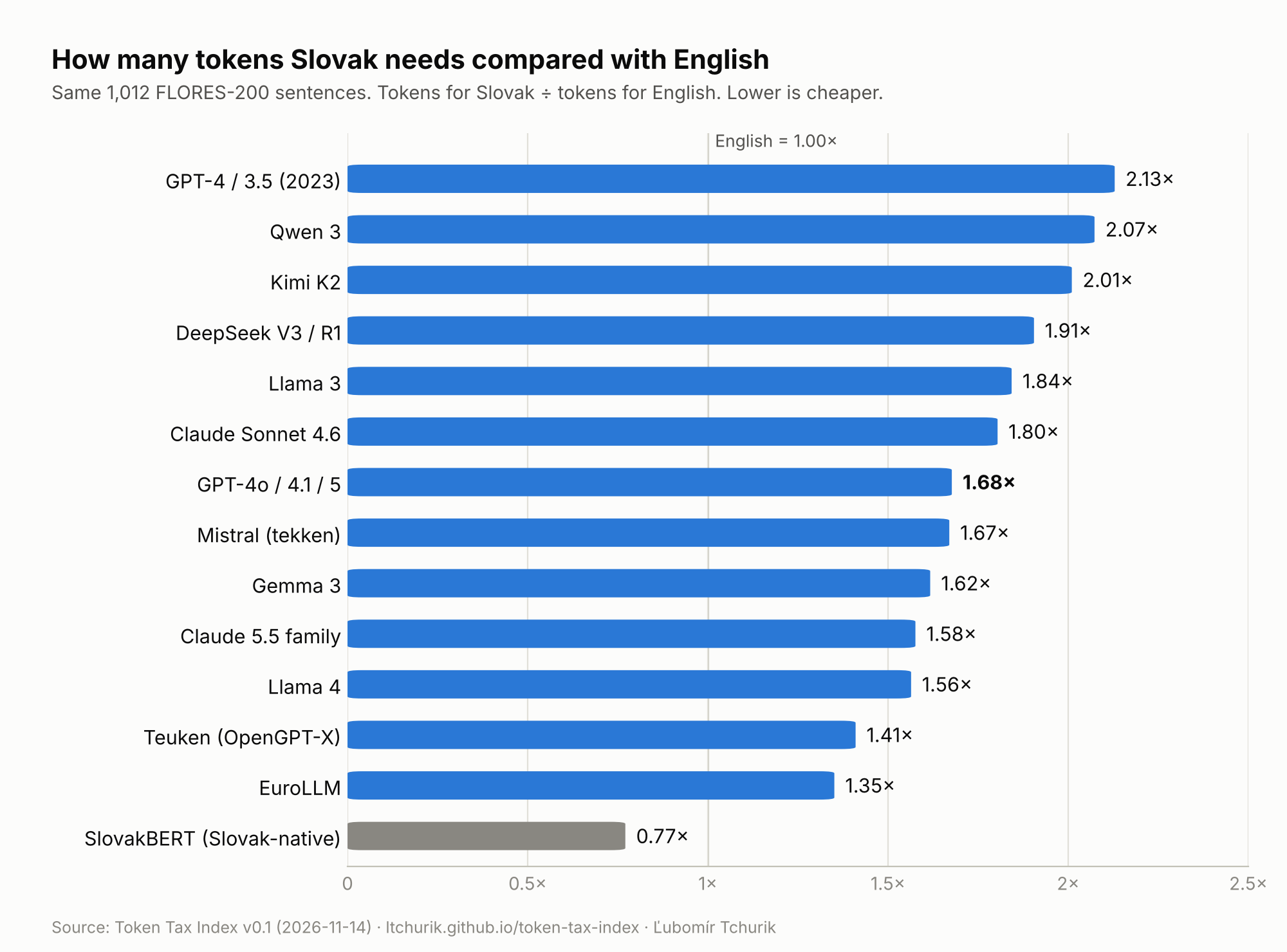
- Slovak needs 1.68× the tokens of English on the tokenizer behind GPT-4o, GPT-4.1 and GPT-5. On the 2023 GPT-4 tokenizer it was 2.13×.
- Across all 35 tokenizers the median Slovak “tax” is 1.81×. The best general-purpose model is Llama 4 at 1.56×; the worst is Falcon 3 at 2.27×.
- Only the European-trained tokenizers come close to parity: EuroLLM 1.35×, Teuken 1.41×. A Slovak-native tokenizer (SlovakBERT) actually beats English at 0.77×, which tells you the gap is a choice, not physics.
- Slovak isn’t special. On GPT-5’s tokenizer 161 of 204 languages pay at least 1.5× and 42 pay 2× or more. Santali pays 13.7×.
What “68% more” actually costs you
Token pricing is linear, so the ratio is the bill. Three things happen at once:
- Money. A workload that costs €1,000 a month in English costs €1,680 in Slovak on GPT-5, €1,800 on Claude Sonnet 4.6, €2,070 on Qwen 3. Same prompts, same answers, same quality target.
- Context. A 128k-token window holds 128k tokens, not 128k words. In Slovak that is roughly 40% fewer words of your documents, your RAG chunks, your conversation history. The model “forgets” sooner.
- Latency. Output is generated one token at a time. A Slovak answer with the same information takes 1.6–2× as many steps, so it streams visibly slower. Your users notice this before they notice the invoice.
And here is the part that stings: raw UTF-8 bytes for Slovak are only 9% more than English for the same text. The language isn’t longer. The tokenizer just doesn’t know it.
Why Slovak gets chopped into confetti
A tokenizer is a compression dictionary built from training text. Byte-pair encoding looks at billions of sentences and learns which chunks appear often enough to deserve their own entry. English has had the most text on the internet for thirty years, so the dictionary is full of English: “the”, “ing”, “tion”, whole common words. On GPT-5’s tokenizer an English token averages 4.9 characters; a Slovak token averages 2.9.
Slovak then makes it worse in three specific ways:
- Diacritics. č, š, ž, ť, ď, ľ, ň, ô, ä are two bytes each in UTF-8. If the tokenizer never learned “ľudí” as a unit, it may split it into
ľ+ud+í, and that first piece can be a single byte of a two-byte character. - Inflection. English has “house, houses”. Slovak has dom, domu, domov, domy, domom, domami, dome… Every form is a separate string the tokenizer must have seen often enough to memorize. It hasn’t.
- Not enough Slovak in the corpus. This is the real one. Czech, with roughly twice the web presence, consistently scores a few points better than Slovak on the same tokenizer (1.60× vs 1.68× on GPT-5). Polish, with four times the speakers, is 1.64×. The tax tracks the amount of training text, not the difficulty of the language.
The models that got better — and the ones that didn’t
The good news is in the GPT line. OpenAI’s 2023 tokenizer (cl100k_base, GPT-4 and GPT-3.5) charged Slovak 2.13×. The 2024 one (o200k_base, everything from GPT-4o to GPT-5) charges 1.68×. Doubling the vocabulary to 200k entries bought Slovak a 21% discount without anyone announcing it. Anthropic went the same way: Claude 2 was 2.25×, Sonnet 4.6 is 1.80×, the 5.5 family is 1.58×.
The bad news is in the open-weight models people self-host to save money. Qwen 3 (2.07×), Kimi K2 (2.01×) and DeepSeek V3 (1.91×) are all worse than GPT-5 for Slovak. They are excellent models, and their tokenizers are built for Chinese and English. If you run them on Slovak text, the “cheap” model needs a quarter more compute per sentence than the API you were trying to replace.
| Tokenizer | Slovak | Czech | Polish | Hungarian | German |
|---|---|---|---|---|---|
| EuroLLM | 1.35× | 1.34× | 1.22× | 1.44× | 1.22× |
| Teuken (OpenGPT-X) | 1.41× | 1.06× | 1.10× | 1.11× | 1.14× |
| Llama 4 | 1.56× | 1.47× | 1.40× | 1.56× | 1.30× |
| Claude 5.5 family | 1.58× | 1.42× | 1.60× | 1.56× | 1.74× |
| Gemma 3 | 1.62× | 1.52× | 1.51× | 1.68× | 1.33× |
| GPT-4o / 4.1 / 5 | 1.68× | 1.60× | 1.64× | 1.79× | 1.31× |
| Claude Sonnet 4.6 | 1.80× | 1.64× | 1.72× | 1.78× | 1.76× |
| Llama 3 | 1.84× | 1.50× | 1.89× | 2.12× | 1.58× |
| DeepSeek V3 / R1 | 1.91× | 1.70× | 1.68× | 1.99× | 1.51× |
| Qwen 3 | 2.07× | 2.06× | 1.76× | 2.12× | 1.56× |
| GPT-4 / 3.5 (2023) | 2.13× | 2.10× | 1.91× | 2.15× | 1.59× |
What I’d actually do about it
You can’t change the tokenizer of a hosted model. You can change what you send it.
- Put the tax in your budget before you pick a model. Multiply every English price-per-million by the ratio for your language. A 20% cheaper model with a 25% worse tokenizer is not cheaper.
- Keep system prompts and tool schemas in English. They are sent on every call and they are the one part of the prompt whose language you control. The user’s text can stay Slovak; the 800-token instruction block doesn’t have to.
- Size RAG chunks in tokens, not characters, and measure them with the real tokenizer. A chunker tuned on English documentation will overflow on Slovak.
- Prefer the newer tokenizer family. If you are still on a GPT-4-era or Llama 3-era deployment for a Slovak workload, moving to a 200k-vocabulary model is a 15–20% cost cut with no quality trade-off.
- For self-hosting, test EuroLLM and Teuken first. They were trained with Central European text on purpose, and on Slovak they are the only ones under 1.5×.
- Check your own text. I built a Slovak token calculator that runs in the browser; paste a real prompt and see the count on each tokenizer before you commit.
How this was measured
The corpus is FLORES-200 devtest: 1,012 sentences from Wikipedia, professionally translated into 204 languages, so every language carries exactly the same information. Each sentence set is run through each tokenizer; the ratio is total tokens for the language divided by total tokens for English, with a bootstrap 95% confidence interval. Commercial tokenizers (OpenAI, Anthropic) are measured through their official libraries or token-count APIs; open models through their Hugging Face tokenizers. Everything is in the repository under MIT, the data has a DOI, and anyone can rerun it. If you find a tokenizer I missed, open an issue.
One caveat worth saying out loud: a cheaper tokenizer is not a better model. Teuken compresses Slovak well and still answers worse than GPT-5. The ratio tells you what you pay per sentence, not what you get back. For that I run a separate benchmark, sk-llm-eval, and that is a different article.
FAQ
Why does Slovak cost more than English in ChatGPT or the OpenAI API?
Because the tokenizer’s vocabulary was learned mostly from English text. Slovak words, especially inflected forms with diacritics, are split into more and smaller pieces, and the API bills per piece. On GPT-5’s tokenizer Slovak needs 1.68× the tokens of English for the same content.
Which LLM is cheapest for Slovak text?
By token count alone: EuroLLM (1.35×) and Teuken (1.41×) among open models, Llama 4 (1.56×) and the Claude 5.5 family (1.58×) among mainstream ones, GPT-5 at 1.68×. Multiply by each provider’s price per million tokens to get the real cost.
Is Czech cheaper than Slovak in LLMs?
Slightly, on almost every tokenizer: 1.60× vs 1.68× on GPT-5, 1.42× vs 1.58× on Claude 5.5. Czech has more training text on the web; the languages are otherwise structurally similar.
Does the token tax affect answer quality?
Indirectly. More tokens per sentence means a shorter effective context window and slower output, and models that tokenize a language poorly usually also saw less of it during training. But the ratio itself measures cost, not quality; use a task benchmark for that.
Ľubomír Tchurik is an infrastructure and AI engineer in Bratislava. He runs the servers behind several Slovak news sites and builds open benchmarks for Slovak and other small languages. Data: Token Tax Index, DOI 10.5281/zenodo.24253588. More at lubomirtchurik.sk.

